













Long before mathematics formalized it, clustering existed in the human mind.
When we look at the stars, we see constellations. When we meet people, we sense tribes.
Our perception is built to seek order through resemblance. The act of grouping, whether of shapes, faces, or sounds, is one of the oldest cognitive instincts.
Machine learning inherited this instinct. Among the earliest data-driven techniques later adopted by AI was the idea of clustering, organizing what exists into meaningful groups. It requires no teacher, no labels, only the natural geometry of proximity.
Clustering is not about intelligence but about order. It arranges the world into neighborhoods of similarity, creating maps where things that are alike stand together and things that differ drift apart.
Imagine looking up at the night sky. The stars form no true patterns, yet the human eye connects them into shapes, stories, and families of light. Clustering does the same: it finds constellations in data.
Learning Without Guidance
Before the rise of self-supervised systems, most artificial intelligence depended on supervision. Humans had to label everything. A photograph needed to be called “cat” or “car.” A sentence needed to be tagged as “positive” or “negative.” The machine learned what it was told.
Clustering offered a different path. It asked, what if we let the machine look at the data and decide what belongs together. Could it find categories on its own.
The answer was yes, and it marked the beginning of unsupervised learning. The machine did not need to be told what it was seeing. It needed only a way to measure distance.
You can think of it like a child exploring a toy box. The child separates blocks from dolls, cars from crayons, without anyone giving instructions. Clustering imitates this first act of discovery.
The Mathematics of Grouping
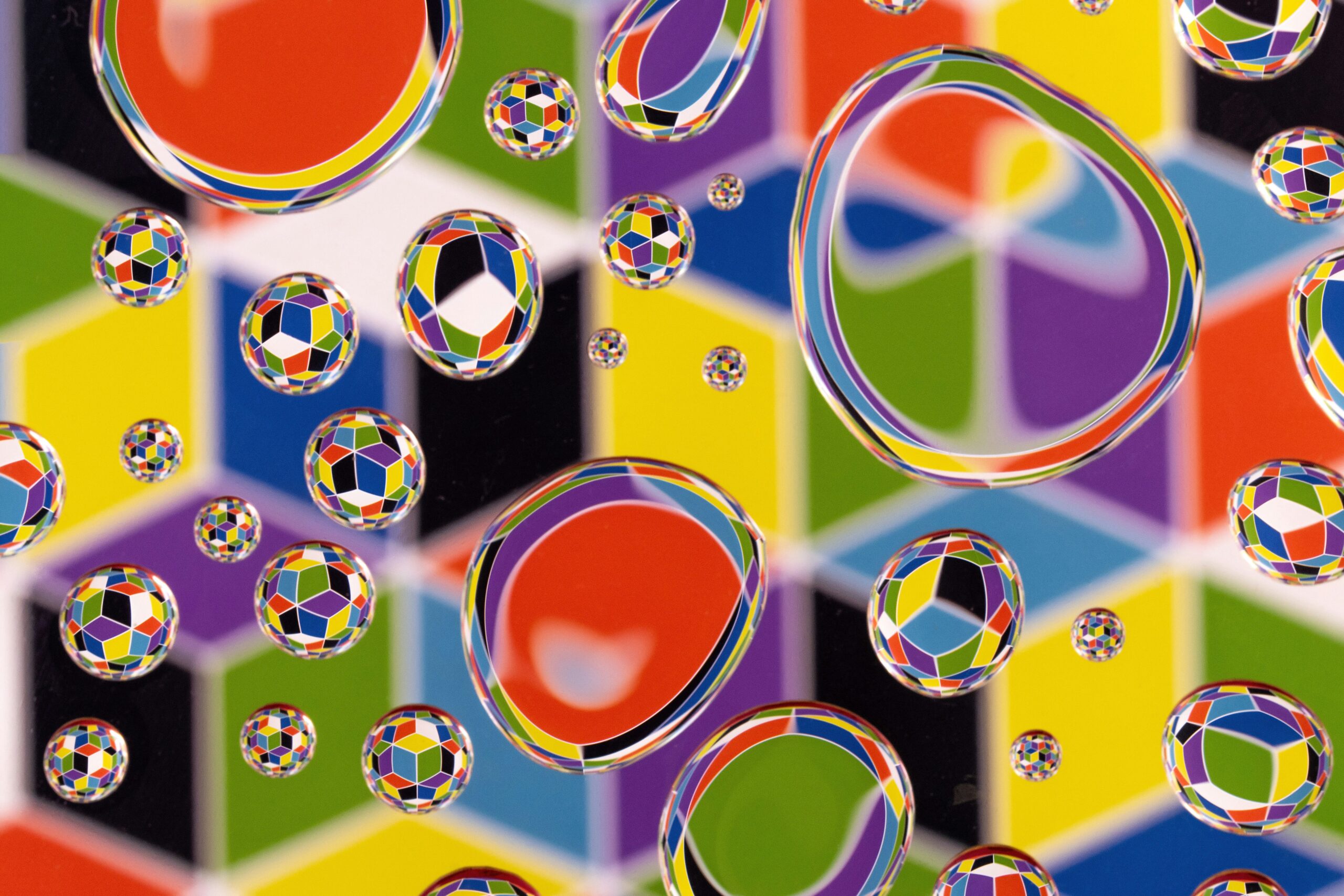
Imagine walking into a room where hundreds of small balls are scattered across the floor, some deep red, some bright yellow, some pale blue. If you measure how far each ball lies from the others, clusters of similar colors begin to appear like tiny constellations on the ground. That is clustering in its simplest form.
Mathematically, each object, a ball, a photograph, a customer, or a word, becomes a point in a high-dimensional space. Each point has coordinates that describe its features. Clustering algorithms measure distances between these points and group those that lie near one another.
In the most common method, called k means, the process begins by choosing a few centers, or centroids. Each point is assigned to the nearest center. Then the centers move to the average position of their assigned points. The process repeats until the centers and their members stabilize.
Other methods, such as hierarchical clustering, build trees of similarity where large groups split into smaller ones according to finer distinctions. Gaussian mixture models allow overlaps, letting one point belong partially to several groups, reflecting the ambiguity of real data.
The result in every case is a geometry of similarity. Proximity becomes meaning.
Clustering in the Real World
Clustering is not only a mathematical curiosity. It underlies much of what we experience in modern analytics.
In business, it organizes customers by behavior. A supermarket might discover that the same customers who buy baby formula also purchase caffeine drinks and sleep aids. The algorithm does not know what new parents are, but the cluster quietly reveals them.
In finance, clustering helps detect anomalies. A group of transactions that suddenly behaves unlike the rest may signal fraud. In marketing, it allows companies to tailor messages to different segments without ever defining those segments in advance.
In biology, clustering helps scientists group species by genetic similarity or detect cell types in complex tissues. Two cells may look identical under a microscope but express genes differently, and clustering exposes the hidden difference.
In astronomy, it identifies galaxies that form groups through gravity. In linguistics, it clusters words that share similar contexts, revealing the unseen grammar of association. If we cluster the words “king,” “queen,” “prince,” and “princess,” they naturally fall together into a family of meaning, the space of royalty.
Every field that deals with data can find hidden order through clustering. It is the first step in seeing structure where none was labeled.
The Limits of Distance
Yet clustering has clear limits. Distance, by itself, cannot capture meaning. Two photographs of cats may look very different in color and shape but still belong to the same concept. A single numerical metric cannot easily express what makes them belong together.
Clustering also depends on the features chosen to represent data. If the features are shallow, the clusters will be meaningless. If they capture only color but not form, a red car and a red apple will end up neighbors, while two cars of different colors may drift apart.
Another limitation lies in its stillness. Once features are fixed, the geometry is frozen. The algorithm can only partition what it is given; it cannot reshape the space itself to bring related ideas closer or push unrelated ones apart. Clustering classifies, but it does not learn.
In very high dimensions, distance itself becomes unreliable. As the number of features grows, all points begin to seem equally far apart, a phenomenon known as the curse of dimensionality. This is why clustering often follows dimensionality reduction, such as principal component analysis, to compress the data into a more meaningful form.
Clustering is a mirror of our own perception. We too rely on surface resemblance. It shows how fragile similarity can be when meaning hides beneath appearance.
The Beauty of Simplicity
Despite its weaknesses, clustering has an enduring beauty. It mirrors how the human brain begins to organize experience in infancy. A child first groups shapes by similarity before learning their names. Apples, pears, and peaches belong together long before the word “fruit” appears.
In the digital world, clustering remains powerful because it is interpretable. Each cluster can be inspected, described, and labeled after discovery. It provides a visual map of patterns that might otherwise remain hidden.
Analysts can see market segments forming naturally, medical researchers can find hidden patient groups, and social scientists can observe how opinions cluster across populations. In this sense, clustering is not only a mathematical method but a lens through which to view complexity.
It is like watching fog lift from a landscape. The forms were always there; clustering simply reveals their outline.
The Threshold of Intelligence
Clustering alone cannot invent meaning, but it creates the conditions for meaning to emerge. By organizing data into regions of similarity, it builds a foundation upon which more advanced learning methods can act.
It is the transition between description and discovery. It shows where boundaries might exist, but not why. The next generation of learning systems would take that step, not just dividing space but reshaping it.
That transformation gave rise to contrastive learning, where meaning emerges not from stillness but from motion, not from proximity but from relation. In contrastive systems, the machine learns not just that two things are close but why they differ, moving from clustering to understanding.
Clustering is therefore not the end of learning but its beginning. It is how intelligence, both natural and artificial, first learns to see the world as a pattern waiting to be named.