







Artificial intelligence dazzles us daily. It paints portraits in the style of Rembrandt. It composes music that echoes Mozart. It drafts legal briefs and even proposes scientific papers. To many, these feats seem like magic. They look like creativity itself, as if silicon were learning to dream. Headlines declare that machines are now artists, thinkers, even inventors. The spectacle is hard to resist.
Yet what looks like wonder is only illusion. This is not imagination. It is only our past, reflected back to us in clever disguise. AI does not dream. It recombines. It stitches together patterns it has already seen. It is an engine of probability, not possibility.
Only humans imagine.
Imagination is not prediction. It is not memory. It is not probability. Imagination is the leap into what does not yet exist. It is the power to see a wheel before it turns, to picture electricity before it shines, to hear music before it is played. As Einstein once said, “Imagination is more important than knowledge.”
Every leap in human history, the printing press, vaccination, the microprocessor, the internet, was born from this leap. These were not extrapolations from data. They were acts of imagination.
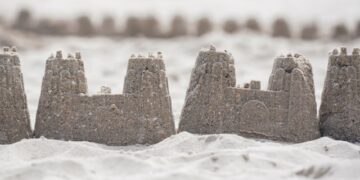
Nothing in a pile of sand suggested the microchip. But humans saw it. Shockley, Kilby, Noyce, they imagined electrons flowing through etched silicon as thought itself. From that came the transistor, the integrated circuit, and the digital revolution.
AI cannot do this. It has no self to wonder, no curiosity to follow, no courage to risk. It cannot know what the “unknown” is. It can only remix what humans already discovered. When ChatGPT writes a poem or MidJourney generates a painting, the results may impress. When AI assembles a “new” Beatles song, it may sound fresh. But it is still stitched together from what already exists. The Beatles imagined what never existed before. AI cannot.
Imagination is the act of stepping onto a bridge that has not yet been built. AI can only walk across bridges already laid.
The danger is not in what AI does but in what we forget. If we confuse recombination with imagination, we may neglect the very trait that has always propelled human progress. If children outsource their essays to AI, they risk outsourcing their imagination itself. And without imagination, no society moves forward.
AI will transform industries. It will accelerate drug discovery, streamline logistics, model financial systems. But it will never invent their foundations. It will never create the next paradigm. That remains human work.
The task before us is simple and urgent:
• Use AI as a tool, powerful, but only a tool.
• Protect and nurture the human gift of imagination.
Because imagination, not calculation, is what changes the world. The future will not be imagined by machines. It will be imagined, or not imagined, by us.