











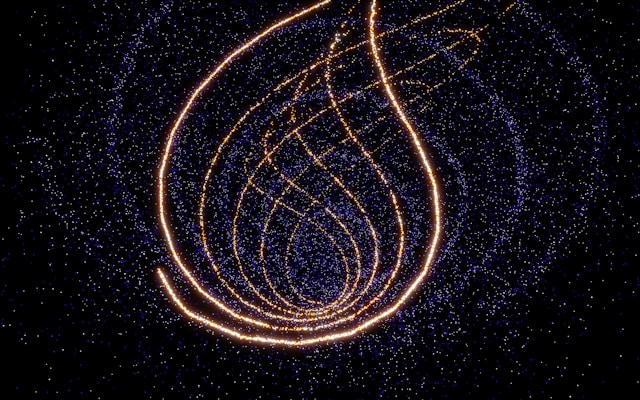
The Spiral as the Memory of the Network
Imagine a tiny spark of light drifting through a cloud of dust. It moves without direction, buffeted by invisible winds, taking countless random steps. If you could trace its path, it would look like a scribble, a restless dance with no pattern or purpose. Yet somewhere within that confusion lies an order waiting to be rediscovered.
That image captures the secret at the heart of modern artificial intelligence. Every AI system that generates pictures, text, or sound begins not with structure but with noise, pure randomness. From that chaos, the model learns to find its way back to meaning, as if retracing the invisible thread that connects confusion to clarity.
To understand this, researchers designed one of the simplest and most elegant demonstrations in AI science: the two-pixel spiral. It shows how learning emerges not through memorization but through motion. It reveals that intelligence begins as a journey through uncertainty.
Seeing Images as Points in Space
An image may appear as a flat picture on a screen, but mathematically it lives in an immense universe of numbers. Every pixel, every color, every shade of brightness forms a dimension in that universe. A small image with a million pixels exists in a space of a million dimensions, far beyond human imagination.
We cannot visualize such a vast space, but we can imagine a simpler version. Suppose an image had only two pixels: one on the left, one on the right. If both pixels are dark, the image belongs to one corner of a graph. If one brightens, the point moves in another direction. If both glow, it drifts to yet another place. Each possible combination of the two pixels becomes a point in this little world.
Now imagine we have many of these two-pixel images. Their relationships form a pattern, perhaps a spiral of points twisting gently across the graph. That spiral represents the hidden structure connecting the pixels. It is the pattern we want the model to learn.
In the simplest possible form, the spiral becomes a metaphor for knowledge itself, a shape of order drawn inside the immense space of possibilities.
When Randomness Reigns
Training a diffusion model begins not with creation but destruction. We take that perfect spiral and begin to add random noise to every point. At first the spiral only trembles, its shape still recognizable. But with every small addition of randomness, the pattern becomes harder to see. After enough steps, the spiral dissolves entirely into a cloud of chaos.
This process is called diffusion, a name borrowed from physics. In the natural world, diffusion describes how particles of dye or pollen drift through water, spreading evenly over time. Under a microscope, each particle jitters and wanders endlessly. The motion seems meaningless, yet it follows precise mathematical laws.
Our data behaves the same way. Each point that once belonged to the spiral takes a random walk through the vast space of images, slowly forgetting its origin. Eventually, every trace of order disappears. The spiral’s memory is gone, replaced by pure noise.
And that is precisely where learning begins.
Reversing the Walk
Now comes the miracle, or rather, the clever trick that makes generative AI possible.
We ask the model to reverse time. We show it thousands of examples of how structure decays into noise, and then challenge it to do the opposite: to begin with chaos and restore the lost pattern. It must learn to predict, for any given noisy point, the direction that leads back toward clarity.
This reversal is not magic; it is learning in its purest form. Each point in the cloud does not know where it started, yet by observing many examples, the model begins to sense which way meaning lies. Over time, it develops a field of invisible guidance, a vector field, that tells it how to move through the noise toward structure.
Every arrow in that invisible field points toward regions of higher probability, the places where real data tends to live. Once the model learns this field, it can start anywhere, even from total randomness, and gradually drift along those arrows back toward an image that makes sense.
In the two-pixel world, it means rediscovering the spiral. In our world, it means creating a cat, a mountain, or a dream that never existed before.
How the Model Learns to Reverse Noise
Beneath this poetic surface lies a disciplined process of learning. The network that performs this transformation is typically a U-Net, a type of deep neural network shaped like the letter U. One half compresses information, capturing the broad shapes of an image; the other half expands it again, restoring fine details.
During training, the model is shown millions of examples of images with varying amounts of noise added. Its task is simple but powerful: at each step, it tries to guess what portion of the image is noise. If it predicts correctly, it is rewarded. If not, it adjusts its internal connections, tiny numerical weights that together represent knowledge, to do better next time.
Through repetition, the model learns a remarkable skill. Given any noisy image, it can tell in which direction to move to make it clearer. It never stores the original images; it stores only the direction of clarity.
Once this ability is learned, we can start from pure static, like the hiss of an untuned radio, and apply the model’s learned sense of direction step by step. Each movement removes a little noise, shapes a little structure, and refines a little meaning. After hundreds of such steps, a coherent image appears.
This process is known as sampling, the act of drawing something new from the model’s understanding of reality. When guided by a text description, it becomes the engine behind systems such as DALL·E or Midjourney, capable of painting anything from “a red fox in the snow” to “a castle floating among the clouds.”
The Shape of Learning
The two-pixel spiral is not just a toy experiment; it is a mirror held up to learning itself.
When we study something new, we begin surrounded by noise. Facts feel unconnected. Ideas clash. Patterns hide beneath confusion. Gradually, relationships appear. The cloud of uncertainty begins to twist into a spiral of understanding.
Learning, whether in machines or minds, is the art of finding order in apparent chaos.
The spiral reminds us that intelligence is not built by stacking facts but by discovering how they connect. Each loop through confusion brings us closer to comprehension. The shape of learning is circular, not linear, a continual return from noise to structure, from disorder to insight.
The Dance of Probability
To understand what the model is truly doing, we need to look at probability, not as numbers, but as landscapes of meaning.
When all data is pure noise, every image is equally unlikely. The landscape of probability is flat. But as the model learns, that landscape begins to form valleys and ridges. The valleys are the places where real, meaningful data tends to lie, the regions of high probability.
As the diffusion model works backward through the noise, each point slides gently downhill, following the gradient of probability toward one of these valleys. That motion, from the improbable to the probable, is called probability flow.
In this way, the model becomes a navigator of possibility, tracing meaning through mathematical space. It learns the terrain of meaning and moves naturally toward it. From this perspective, intelligence itself, whether in a neuron, a model, or a mind, can be seen as the ability to follow the slope of probability toward understanding.
Time as a Teacher
The spiral experiment also reveals something profound about time.
At the beginning of the reverse process, when everything is noise, the model’s task is broad and approximate. It only needs to point generally toward structure. But as the steps progress and the spiral begins to reappear, the task becomes increasingly delicate. Each movement must align precisely with the subtle curves of the pattern.
To handle this, diffusion models learn to condition their predictions on time. At each moment they know how far they are from the goal. Early in the process, they focus on large corrections, removing the obvious randomness. Later, they refine tiny details, sharpening edges and textures.
Human learning follows the same rhythm. At first we grasp rough outlines; later we master subtleties. Time structures intelligence, both artificial and biological. Progress unfolds in stages, from broad exploration to precise understanding.
We begin in noise, move through structure, and arrive at clarity.
How the Spiral Guides Creation
When you first study artificial intelligence, the concepts can feel abstract and confusing. Equations blur together, and each new term seems disconnected from the rest. It is like standing inside the spiral after too much noise has been added, the pattern is hidden, though it still exists.
This wandering through confusion is not wasted time. It is the essential motion of learning. The mind cannot find clarity without first exploring uncertainty. Every question, every false start, every partial insight acts as a step in the diffusion process.
Each time you revisit an idea, your internal vector field becomes more refined. You begin to sense which direction leads toward meaning. Eventually, the scattered points of your knowledge coalesce, and a spiral of understanding appears, elegant, coherent, alive.
Learning, in both humans and machines, is not about escaping confusion but about learning how to navigate it. The noise is not the enemy of understanding; it is the raw material from which understanding emerges.
The Music of Randomness
Noise seems like the opposite of structure, yet without it, no structure could form.
If we removed randomness from a diffusion model, every image it generated would be identical. It would repeat the same pattern endlessly, like a song caught in a loop. Noise gives the model the freedom to explore. It allows variation, creativity, and surprise.
Each new image begins with a different arrangement of random points. As the model applies its learned sense of direction, those points unfold into new but familiar shapes. The result is both consistent and unique, like melodies built from the same scale but never played the same way twice.
Our own minds work similarly. Mistakes, doubts, and detours are not failures but sources of diversity. They keep thought alive. They prevent the collapse into predictable routine.
The spiral of learning wobbles and loops, but always moves toward deeper understanding. In this dance between randomness and structure, intelligence finds its rhythm.
The Geometry of Understanding
Inside a trained diffusion model lies something extraordinary: a hidden geometry of meaning.
Through learning, the model builds an internal map of where meaningful images live. Points that represent similar concepts, such as faces, skies, or forests, cluster near one another. Points that differ lie farther apart. The model has learned the geometry of its universe without being told what the universe is.
This geometry is not just mathematical. It is conceptual. Two images of sunsets may be close together because they share a common pattern of light and color. Two portraits may cluster because of symmetry and texture. The model has, in effect, learned relationships.
When we think, we do something similar. Ideas exist in our minds not as lists but as constellations. Concepts close in meaning sit near one another in our imagination. Creativity happens when we move between those clusters, when we find bridges between distant ideas.
The diffusion model, in its own way, mirrors this geometry of thought. It learns to travel smoothly through meaning, turning points in space into patterns that resonate with us as images.
From Spiral to Cosmos
The two-pixel spiral may seem tiny, but its lesson expands infinitely. Add more pixels, and the spiral becomes a galaxy. Each image, text, or sound becomes a constellation of points scattered across an unimaginable space.
A diffusion model learns to navigate this cosmos, to travel from the scattered stars of noise back to the bright constellations of reality. It does not know what an image is or what beauty means, yet it knows the direction that leads toward coherence.
From that single rule, move toward what is probable, what has structure, entire worlds emerge.
Each time the model generates a new image, it performs an act of reconstruction. It recalls the hidden order that once lay within the noise, reassembling fragments into form. In doing so, it demonstrates one of the most profound truths about intelligence: that creation is an act of memory, not of copying but of remembering structure.
Every image it paints is a rediscovery of the spiral that defines order within chaos.
What the Spiral Teaches
For students of AI, the spiral is more than an illustration. It is a philosophy of learning.
It reminds us that progress is not a straight line. Understanding requires disorientation. A diffusion model learns only by being shown noise again and again until it learns how to undo it. The same is true for us. Confusion is not the absence of knowledge; it is the beginning of it.
Each failed attempt, each unclear idea, is a data point in your own diffusion process. When you struggle to connect concepts, you are walking through the cloud of noise. With every revisit, your mental field adjusts. You begin to sense direction. Eventually, you find yourself tracing the spiral back to meaning.
Learning is persistence through uncertainty. Intelligence, whether artificial or human, is the ability to keep moving when the path is hidden.
The spiral is not a symbol of perfection but of motion, the continual turning of curiosity through confusion toward clarity.
Epilogue: Returning to the Spiral
Stand again before the cloud of scattered points. Somewhere within it lies the spiral you began with, invisible but not gone. Folded inside the noise, waiting to be rediscovered, it represents everything a diffusion model or a learner hopes to find.
To learn is to reverse entropy, to find signal within confusion, form within formlessness, meaning within randomness.
Every time an AI system creates a new image from static, it performs this act of recovery. It walks backward through uncertainty toward coherence. Every time we understand something new, we do the same.
The diffusion model is more than a tool; it is a metaphor for the human condition. We too begin in noise, in questions, in doubt, in curiosity, and through exploration we uncover the spirals that connect scattered facts into knowledge.
In the end, learning is not about formulas or algorithms. It is about direction, the steady movement toward understanding, even when everything around us seems lost in noise.
Like the diffusion model finding its way through chaos, the mind too learns to walk backward through time, tracing again the spiral of meaning hidden within the storm of randomness.