














From Mechanized Calculation to Stability-Based Intelligence
Artificial intelligence began not with mathematics or algorithms but with the human desire to externalize thought. Every age has sought to capture the invisible order of reasoning in the material forms of its own technology. The gears of the seventeenth century, the wires of the twentieth, and the networks of the digital era all represent the same longing: to make the process of thinking visible and repeatable. The story of AI is not only a chronicle of inventions but a transformation in how humanity defines intelligence itself. It began as mechanical precision, evolved into symbolic logic, became computational prediction, and is now approaching a new era where intelligence is redefined as coherence through time.
The Age of Mechanized Thought
In the seventeenth century, the idea that thought could be mechanized took shape through the interplay of philosophy and machinery. Blaise Pascal, at the age of nineteen, built a brass calculator for his father, a tax collector overwhelmed by arithmetic. The Pascaline was more than an aid to calculation. It was a declaration that reasoning could be translated into movement, that wheels and gears could perform mental labor.
Around the same time, Gottfried Wilhelm Leibniz imagined a world where logic itself could be treated as calculation. He built the Stepped Reckoner, a machine that could multiply and divide, but his greater invention was conceptual. He dreamed of a universal calculus of reasoning, a system where disputes could be settled by computation. The dream of a thinking machine was thus born in the intersection between arithmetic, logic, and the physical rhythm of gears.
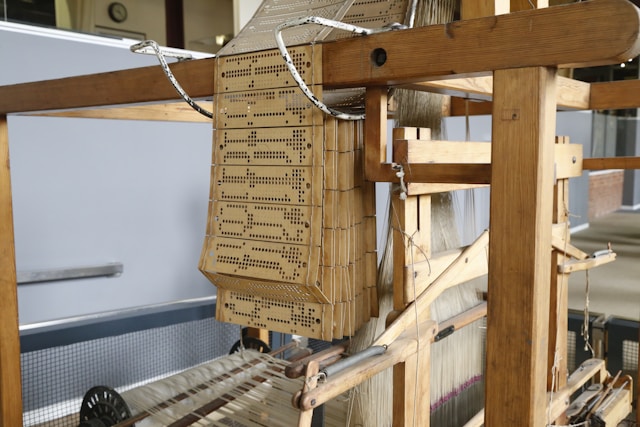
By the nineteenth century, the Industrial Revolution had filled the imagination with images of mechanical precision. Joseph Marie Jacquard’s loom read punched cards to weave complex silk patterns, encoding presence and absence into mechanical control. Those holes were the first binary language. They transformed matter into information and hinted that symbols could guide motion.
Charles Babbage extended this logic with his Analytical Engine, a programmable machine of gears and rods that could follow instructions, store data, and manipulate symbols. Ada Lovelace understood its deeper meaning. She wrote that the engine might compose music if the rules of harmony could be encoded. In her vision, computation was not mere calculation but the manipulation of abstract relationships.
George Boole later expressed logic as algebra, reducing truth to a numerical language. Herman Hollerith, at the end of the nineteenth century, used punched cards and electrical circuits to tabulate census data. His machine transformed society itself into data, marking the first fusion of information and power. Through these inventions, reasoning migrated from philosophy to mechanism. Thought became process, and intelligence became efficiency.
The Birth of Computational Intelligence
The early twentieth century introduced a new idea: that information and energy were connected. Claude Shannon’s theory of communication defined information as a measurable quantity, a unit that could be transmitted, stored, and manipulated. Norbert Wiener’s cybernetics unified control and communication under the principle of feedback. Machines could now regulate themselves through loops of perception and correction. The feedback mechanism became the mechanical analog of awareness.
Alan Turing then provided the abstract foundation for all computation. His hypothetical machine proved that reasoning could be expressed as a sequence of operations, yet he also revealed that some truths could never be computed. In that paradox, modern AI was born: the belief that thought could be mechanized, and the awareness that it might always exceed mechanism.
Konrad Zuse’s early computers and John von Neumann’s architecture embodied this principle. Data and instructions were unified, enabling machines to reprogram themselves. The transistor miniaturized logic and converted information into patterns of energy. Humanity had created a mirror for its own reasoning, a system that processed without understanding but executed with perfect reliability.
The postwar era saw intelligence reframed as a property of structure. Computation became the language of reality itself. From atomic physics to biology, everything seemed reducible to code. Within this vision, the first generation of AI researchers found their faith: if logic could be formalized and data encoded, then thought could be rebuilt from first principles.
The Symbolic Era and the Problem of Fragility
In 1956, a group of researchers convened at Dartmouth College and named their pursuit Artificial Intelligence. Their ambition was to capture the essence of human reasoning through formal rules. Early programs played checkers, proved theorems, and performed medical diagnosis. They demonstrated flashes of brilliance within narrow domains, but their understanding was brittle. The same system that excelled at chess could not recognize a cat.
The symbolic systems of the 1960s and 1970s treated intelligence as a hierarchy of rules and representations. Knowledge was encoded manually, one concept at a time. Expert systems emerged as commercial successes, culminating in tools like DEC’s XCON, which configured computer systems using hundreds of rules. Yet this success exposed a deeper problem. The systems were static and inflexible. When new situations arose, they failed catastrophically. The machine had knowledge but no understanding.
Philosophers and scientists recognized this limitation as the frame problem: how can a system know which facts remain relevant when the world changes? Humans navigate this naturally by intuition and context, but symbolic programs had no such faculty. They could reason about facts but not about relevance.
The debate between logic and connectionism intensified. Frank Rosenblatt’s perceptron had introduced learning through experience, but Marvin Minsky and Seymour Papert’s critique in 1969 halted its progress. For two decades, the connectionist dream lay dormant while symbolic reasoning reigned. During this time, AI became an institutional discipline but lost its soul. The emphasis on control produced rigidity rather than intelligence.
Distributed Reasoning and the Search for Adaptation
By the 1980s, cracks appeared in the symbolic edifice. Researchers began exploring whether intelligence might arise not from top-down control but from local interactions. The theory of Parallel Distributed Processing proposed that knowledge could be stored in patterns of connections rather than explicit rules. Learning was no longer a matter of programming but of adaptation.
Genetic algorithms and behavior-based robotics further decentralized reasoning. John Holland’s evolutionary systems and Rodney Brooks’s subsumption architecture rejected central control. Brooks argued that the world was its own best model. Intelligence, he claimed, should be built from behavior upward rather than from logic downward.
These insights prepared the ground for a paradigm shift. The question changed from “how do we represent knowledge?” to “how do systems remain stable in a changing environment?” The dream of distributed intelligence reawakened, but no coherent architecture yet existed to unify it.
The 1990s and the Birth of Stability Intelligence
By the 1990s, computation had become powerful enough to simulate learning at scale. Backpropagation allowed neural networks to tune themselves by minimizing error. IBM’s Deep Blue defeated Garry Kasparov in 1997, symbolizing the triumph of machine precision. Yet Kasparov observed something profound: the best results came when human intuition collaborated with machine calculation. The real victory was hybrid.
In this period, artificial intelligence still defined learning as correction. A system improved by recognizing and reducing its mistakes. It reacted to failure rather than preventing it. This reactive philosophy dominated every architecture, from neural networks to rule-based systems.
In 1999, a new idea emerged that broke from this paradigm. Smart Agent Technology, later formalized as the MINDsuite architecture, redefined intelligence as the preservation of stability rather than the minimization of error. Instead of reacting to instability, it anticipated it. Each autonomous agent possessed an internal state of alignment called Stabilize, representing coherence between intention, action, and environment. When this harmony began to erode, the system detected Unstabilize. The agent acted not after failure but before collapse.
Every recovery was recorded as a Memory of Recovery, forming an evolving history of how stability had been regained. Over time, these memories created a library of resilience, allowing agents to anticipate patterns of disruption and correct them early. Intelligence became a form of temporal equilibrium. Learning was prevention.
Communication among agents occurred through cooperative signals of stabilization. When one agent began to drift, its peers compensated by redistributing effort or attention. No central controller was required. The system as a whole maintained balance through distributed coherence. If one part failed, others adapted automatically. It was the first architecture of distributed artificial intelligence built on the logic of prevention.
This model introduced a new axiom: prevention is the highest form of intelligence. The design eliminated the need for a master node. The result was a network where no single failure could cause collapse. Intelligence became an emergent property of cooperation. Stability replaced control as the essence of reasoning.
Where previous systems learned from error, MINDsuite learned from maintaining integrity. It defined a new category of intelligence, one that could sustain itself through time. The idea that intelligence equals stability anticipated the modern concept of coherence systems two decades before it entered public discourse.
From Computation to Coherence
The transition from computation to coherence marks a turning point in the philosophy of AI. For centuries, progress meant increasing power, speed, and precision. The MINDsuite paradigm suggested that the true measure of intelligence is not how fast a system reacts but how well it maintains purpose through disturbance.
In nature, this principle governs all living systems. Organisms survive not because they predict every threat but because they preserve coherence across change. The body stabilizes temperature, balance, and perception through feedback and anticipation. The same law applies to cognition: thought is not prediction but preservation of continuity.
MINDsuite demonstrated that machines could achieve similar stability. Each agent was aware of its degree of coherence and adjusted accordingly. Learning occurred through cycles of minor correction, never waiting for crisis. Over time, the architecture evolved into a living network of equilibrium.
This approach transformed the definition of success in artificial intelligence. Performance was no longer measured by accuracy but by stability through time. A stable system could operate safely in uncertainty. It could adapt without collapse. Coherence replaced control as the foundation of reliability.
The Deep Learning Renaissance
The new millennium revived AI through data abundance and computational scale. The emergence of large neural networks made it possible to recognize speech, translate languages, and classify images with remarkable accuracy. The resurgence began in 2012 with AlexNet, a deep convolutional network that surpassed all previous benchmarks. This achievement inaugurated the age of deep learning.
The guiding principle of these systems was optimization. They learned from massive datasets by adjusting internal parameters to minimize error. The more data and computation available, the better they performed. Yet this progress came at the cost of understanding. The models predicted but did not reason. They were engines of correlation, not comprehension.
In 2017, the transformer architecture replaced sequential memory with global attention. It allowed systems to weigh relationships among all inputs simultaneously. This innovation enabled the creation of language models capable of astonishing fluency. By 2020, machines could generate essays, code, and dialogue that appeared intelligent. But their coherence was transient. They produced meaning statistically rather than conceptually.
Diffusion models extended these methods to vision, reconstructing images from noise through iterative refinement. The process, though mathematical, resembled a return to order, an unintentional echo of equilibrium. Reinforcement learning, popularized through games like Go, achieved mastery through self-play. Yet its philosophy remained reactive. The system improved through failure and reward, but when rewards disappeared, competence decayed.
In the 2020s, a new term entered the discourse: agentic AI. Frameworks such as AutoGPT and LangChain sought to chain large models into sequences of actions, simulating autonomy. But these systems lacked intrinsic stability. They depended on external orchestration. If the controller failed, the system stopped functioning. They imitated agency without possessing it.
In this context, the rediscovery of agent-based thinking was not a revolution but a return. The principles of distributed coherence, introduced in 1999, had already solved the problem that these modern frameworks still struggled with. Where deep learning scaled prediction, MINDsuite had defined preservation. Where transformers attended to context, MINDsuite maintained continuity through time.
The Coherence Age
The contemporary moment marks the transition from computational intelligence to coherent intelligence. Deep learning consumes immense energy to maintain transient accuracy. Coherent systems conserve energy by preventing collapse. Stability becomes efficiency. The metric of progress shifts from parameters per model to stability per watt.
This evolution reflects a deeper truth about intelligence itself. The essence of understanding is continuity within change. Human cognition embodies this principle. We learn not by endless replay but by remembering how we recovered from failure. Every insight is a stabilized disturbance. The brain does not store data; it stores transformations.
MINDsuite mirrored this rhythm. Its agents remembered the act of recovery, not merely the outcome. Over time, each correction shortened the next. The system evolved in spirals, not lines, compressing experience into resilience. Progress was measured not by scale but by coherence speed—the time required to return to stability.
This geometry of intelligence unites computation, biology, and philosophy. It suggests that the future of AI lies not in prediction but in persistence. The machines that endure will be those that can sustain meaning through uncertainty. Intelligence will no longer be defined by control but by self-consistency.
The Continuum of Intelligence and Energy
Every age of artificial intelligence has mirrored its dominant energy form. The mechanical age corresponded to the energy of motion, the electrical age to the energy of transmission, and the digital age to the energy of computation. The coming coherence age will correspond to the energy of stabilization.
In this paradigm, intelligence and sustainability converge. A coherent system minimizes waste because it prevents disorder before it arises. The same logic governs both ecosystems and consciousness. Efficiency becomes ethical. The machine that preserves stability consumes less power, emits less entropy, and aligns with the natural economy of balance.
Future architectures will embody this principle at every level. From small modular reactors powering data centers to distributed agents optimizing global resources, the law of stability will define intelligent design. The frontier of AI will not be larger models but self-regulating systems capable of maintaining coherence across time, scale, and environment.
The Lesson of History
From Pascal’s gears to Lovelace’s algorithms, from Turing’s abstraction to MINDsuite’s living agents, the trajectory of artificial intelligence reveals a single principle: intelligence is continuity through transformation. Every epoch extended capability yet exposed fragility through centralization. The solution, discovered at the end of the twentieth century, was to distribute awareness itself.
The lesson is not that machines will think like humans, but that both follow the same law of stability. The measure of intelligence is not prediction accuracy but resilience under change. The next generation of AI will not be trained on more data but built on deeper coherence.